
The African AI Renaissance : Navigating governance and trust in 2026
The global economy is being changed due to the increased reliance on Artificial Intelligence. According to PwC, AI’s contribution to global GDP is projected at $15.7 trillion by 2030, which is a 14% boost the world economy. However, governance frameworks have not matched the pace of accelerated adoption.
According to the Global Center on AI, only 39% of the countries in the world have developed a national AI strategy, and less than 30% have binding regulatory frameworks to enforce responsible AI principles. This creates huge gaps in ethics, safety, equity, and accountability.
However, all these paint a picture of rapid growth in Africa’s AI market. In particular, McKinsey & Company in 2023 report The economic potential of generative AI: The next productivity frontier estimates that AI could unlock $ 1.2 – 1.5 trillion additional GDP for Africa by 2030, especially on agriculture, fintech, healthcare, and smart logistics. Yet the continent faces infrastructure constraints: in 2023, only 37% of Africans were found to be using the internet – a figure that illustrates the scope of growth-against-infrastructure constraints.
The narrative on AI in Africa changes. For one, whereas in the past Africa trailed behind in AI-related innovations, the continent is in 2026 not only positioning itself as a mere recipient of AI-driven technologies but also as a proactive regulator of governance frameworks based on its socio-economic experiences.
This leads to the key question of how Africa can establish governance mechanisms that enable it to harness the power of innovation without infringing on human rights and data sovereignty.
1. The Sovereignty Challenge: Moving Beyond Data Colonialism
It is fundamental to regain control of digital assets. Africa produces a lot of raw data which is stored and processed outside the continent. Xalam Analytics estimates that more than 70% of data traffic in Africa is routed outside the continent, raising costs and dependency.
Data sovereignty means the ability to regulate AI systems locally, and also ensure the economic and epistemic value that is generated from African data remains in Africa – strengthening domestic ecosystems instead of reinforcing external dependency.
2.Defining Responsible AI: The African Framework
In Africa, Responsible Artificial Intelligence is guided by three major principles, those of Human Oversight, Fairness and Inclusive Development.
In an African context however, Responsible Artificial Intelligence encompasses much more than these three principles; it addresses structural inequalities, digital vulnerability and economic sovereignty.
At its summit in June 2024, the African Union supported its Continental Artificial Intelligence Strategy (2025-2026) which included:
Mandatory human review for high risk application of artificial intelligence where it impacts credit, employment, healthcare and public services.
Mechanisms that mitigate against bias especially for under-represented and historically disadvantaged populations.
Cross-border regulatory harmonization to support intra-African digital trade via the AfCFTA (African Continental Free Trade Area).
Strategic investment in both talent and research ecosystems.
This comes at a critical juncture. The Stanford University AI Index Report 2024 indicates that Africa has contributed less than 3% of global artificial intelligence research output, and African languages are inadequately represented in large language models resulting in increased risks for algorithmic bias and exclusion.
Additionally, only 41 African nations currently have operable laws relating to data protection and enforcement capability is not uniform across the region as well. Without robust oversight, automated systems used in Finance, Biometric Identification and Predictive Policing could reproduce or increase existing systemic inequities.
Africa is playing an active role in defining the global governance framework for emerging technologies. According to the 2023 United Nations High Level Advisory Board on Artificial Intelligence, emerging economies must participate in developing global standards for the governance of Artificial Intelligence to prevent reliance on technology from developed economies.
Africa is no longer a participant on the fringes of the digital economy as a passive recipient of technology; rather, it is shifting from a rule-taker to a rule-maker by embedding Africa’s values, population, and economic interests into the core infrastructure of Artificial Intelligence governance.
3.Four Foundational Pillars of Governance
To build an ecosystem of trust, The governance must uphold on four pillars :
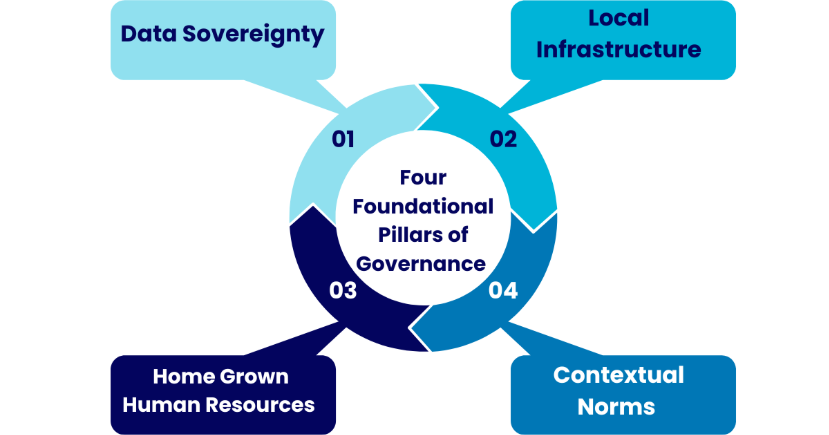
1) Data Sovereignty The fair processing of personal data and its protection under the jurisdiction of the nation. According to the United Nations Conference on Trade and Development, 36 out of 55 African countries have so far enacted data protection laws (2024).
2) Local Infrastructure Currently, Africa hosts less than 2% of data center capacity worldwide, according to the Africa Data Centres Association, highlighting the necessity for strategic investments.
3) Home Grown Human Resources Africa has the youngest population in the world with 60 percent of people below 25 years (United nations data). Building AI skills in-house will help convert this demographic strength into digital dominance.
4) Contextual Norms Regulatory frameworks must reflect societal values, ensuring AI systems are aligned with community-based ethics and cultural realities.
4.From Theory to Practice: Operationalizing the Framework
Governance should be a “how,” not a “no.
African countries are already implementing practical steps:
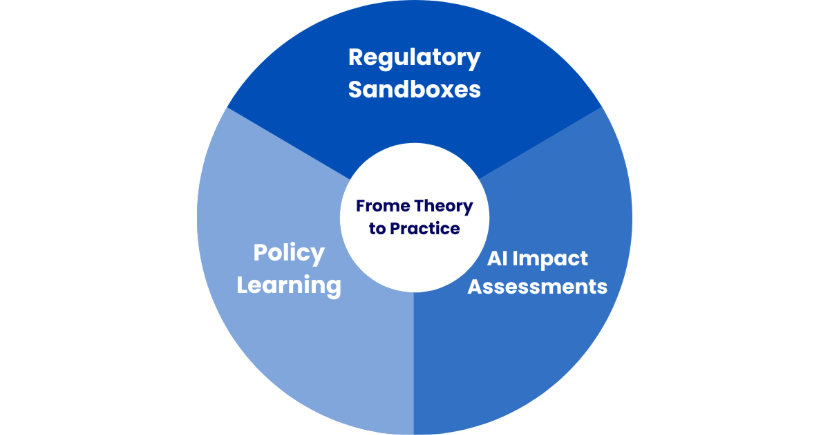
Regulatory Sandboxes: Countries like Nigeria and Mauritius have rolled out fintech and innovation sandboxes to pilot emerging technologies before full-scale deployment.
AI Impact Assessments (AIA): Inspired by the EU model, the African Union framework requires risk assessments before the deployment of high-risk systems.
Policy Learning: Governments are drawing upon telecom and banking regulation experience to fast-track oversight mechanisms over artificial intelligence.
Looking to design your future AI governance framework ?
At Nexfing, we believe governance is not the enemy of innovation – it is a high performance braking system that allows you to move faster and safer.
Market leaders in 2026 will not just be those who first deploy AI, but those who first establish trust.
Need to design your future AI governance framework? Get in touch with Nexfing and turn Responsible AI into your sustainable competitive advantage.
Contact Nexfing and turn Responsible AI into your sustainable competitive advantage.
Sources:
PWC: https://www.pwc.com.au/government/pwc-ai-analysis-sizing-the-prize-report.pdf
Global center on AI Governance : https://www.globalcenter.ai/research/resilience-and-preparedness-in-ai-governance-the-african-perspective
Cambridge University Press (Data & Policy): https://www.cambridge.org/core/journals/data-and-policy/article/toward-a-trustworthy-and-inclusive-data-governance-policy-for-the-use-of-artificial-intelligence-in-africa/6C22513DE8598A0A8B1EDBD9A2D6A102
Thomson Reuters Foundation: https://www.trust.org/resource/2024-ai-governance-for-africa-toolkit/
African Union (AU) Continental AI Strategy: https://au.int/sites/default/files/documents/44004-doc-EN-_Continental_AI_Strategy_July_2024.pdf
Stanford University : https://hai.stanford.edu/ai-index/2024-ai-index-report
African Union: https://au.int/en/documents/20240809/continental-artificial-intelligence-strategy
UNCTAD: https://unctad.org/page/data-protection-and-privacy-legislation-worldwide