
How to Unlock Its Full Value ?
Data is no longer merely a by-product of business operations; it has become a strategic raw material in the modern digital economy. Globally, the big data and analytics market continues its rapid expansion and is projected to reach significant scale in the coming years. According to Fortune Business Insights, the global big data analytics market is expected to surpass $83.79 billion by 2026, reflecting strong and sustained growth as organizations accelerate investments in data-driven technologies.
Across Africa, the opportunity is equally compelling. With a population exceeding one billion people and rapidly increasing digital and mobile penetration, the continent is entering a decisive phase of digital transformation. According to Mordor Intelligence, the African digital transformation market is estimated at approximately $30.24 billion in 2025, with projections reaching nearly $63 billion by 2030, representing a compound annual growth rate (CAGR) of approximately 15.9%. This growth reflects a structural shift in how African enterprises are modernizing operations, infrastructure, and customer engagement through digital capabilities.
More specifically, investment in data analytics technologies across the Middle East and Africa region is gaining momentum. According to Grand View Research, the data analytics market in the African region is projected to reach approximately $15.7 billion by 2030, growing at a CAGR of around 16.8%. This trajectory signals increasing recognition among organizations that analytics is no longer optional but essential for competitiveness, risk management, and performance optimization.
However, infrastructure gaps remain a critical constraint. Despite rising digital demand, Africa still accounts for less than 1% of global data center capacity. According to Agence Ecofin, demand for data center capacity on the continent could triple by 2030, requiring an estimated $10–20 billion in additional investment to support growing digital ecosystems.
This contrast between accelerating digital market growth and limited data infrastructure capacity creates a strategic inflection point. Organizations that successfully transform raw data into structured intelligence while aligning governance, analytics, and business strategy will be positioned to capture disproportionate competitive advantage in Africa’s evolving digital landscape.
This article will discuss the importance of data, the reasons it is underused, and how businesses can capitalize on its full value.
Knowing the Value of Your Data
The sheer magnitude of daily data creation is extraordinary. According to industry estimates, approximately 2.5 quintillion bytes of data are generated globally each day, yet nearly 90% of this data is not used by the organizations that collect it. The global market for data analytics further illustrates the potential for growth, with projections indicating total revenues exceeding $83.79 billion by 2026 (a 28% compound annual growth rate).
These figures show that organizations not only recognize the need for investment in this area but are also allocating significant resources to tools and capabilities aimed at maximizing data value. However, despite these investments, many organizations still struggle to convert raw data into tangible business value. To fully understand this challenge, both the opportunities and the barriers must be examined.
1.The benefits of using data as a value creation tool :

The use of data enhances the quality of decisions made by organizations
Organizations using actual data, as opposed to simply intuition for decision-making is an obvious and quantifiable benefit. Businesses can increase their return on investment (ROI) over a three-year period, by investing in BI and analytics and achieving an ROI greater than 127%. Additionally, the benefits of using data to support decision-making can go beyond simply saving costs; they can also help improve other important business outcomes such as forecasting, resource allocation, and trend analysis.
The use of data for decision-making is growing at a rapid pace, but the effectiveness of using it for this purpose varies widely among businesses.
A majority (80%) of surveyed businesses have adopted some level of data analytics. Furthermore, 83% of these businesses report that data analytics is used for about 70% of all important company decisions. However, there is still considerable variation in how companies align their business strategy with the use of data. Companies that do not have an aligned data strategy are wasting time and money on analytics that do not produce a positive impact on their organizations.
2. The Data Utilization Gap: Why Value Is Still Hard to Achieve

Organizational investment in big data is on the rise, yet the majority of organizations still struggle to turn data into measurable value. The two biggest obstacles that exist for organizations in this process are:
Data Quality Problems
An abundance of data has minimal value if that data is incomplete, inaccurate, or not consistent. According to recent studies, over 70% of data collected by organizations is either incomplete or inaccurate, which inhibits decision making and analytics. Data Quality Issues also hinder digital transformation at a broader level, for example:
– Over 60% of organizations report that they view poor data Quality as a roadblock to the digital initiatives they are developing.
– 50% of organizations indicate that large portions of their data cannot be relied upon to make sound, strategic decisions, The most problematic aspect of these issues is that most organizations assume that just because they have collected significant amounts of data, they have achieved success.
The truth is that Quality of data is far more important than the amount of data available.
Inadequate Returns from Analytics and AI Investments.
While numerous businesses heavily invest in analytics and artificial intelligence (AI), the financial benefit of these investments continues to be limited today. According to a recent survey, only 4% of organizations have experienced significant financial benefits from their AI initiatives; conversely, 68% of executives believe that AI will lead to substantial increases in profits by 2030. The gap between expectation and reality suggests that most data and AI projects fail not due to technology, but rather because they are not adequately governed, aligned with business objectives, or possess enough capabilities to succeed.
3. How Do Organizations Realize Value from Data?
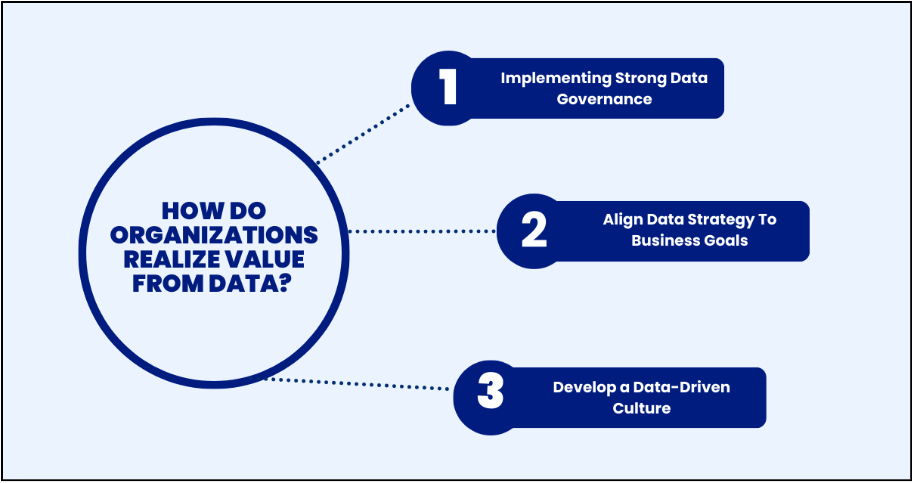
To transform data into a strategic asset, they need to concentrate on three key elements: governance, strategy, and culture.
Implementing Strong Data Governance
Having an effective data governance framework includes policies, standards, and roles that allow for more accurate, consistent, and secure data to be maintained. Organizations implementing strong governance frameworks report improved analytics outcomes:
- 80% feel that data governance is a critical enabler of operational success.
- 70% of organizations with data governance practices see measurable improvements in their decisions made.
- 30% reduction in risk due to poor quality data has been calculated by organizations because of improved governance.
This demonstrates that a good governance framework is important to the business and is not just an IT function.
Align Data Strategy to Business Goals
Data strategies should be aligned with overall company strategy. Deloitte article states organizations that have a core-business asset approach to data achieve 2-3x higher ROI and performance metrics than organizations that do not have a core-business asset approach to both data and technology. Integration of data strategy with business strategy bridges the gap for analytics projects to deliver on priorities such as customer retention, reduced costs, or entering new markets instead of just acquiring technology for its sake.
Develop a Data-Driven Culture
An effective data strategy is only as good as how an organization uses data in their daily decision-making processes. To develop a data-driven culture, organizations should do the following:
• Train their staff on understanding and using data.
• Provide access to user-friendly analytics tools.
• Promote collaboration across departments.
When every team understands how to extract value from data, decisionmaking becomes faster, more confident, and more aligned with strategic goals.
4. The Quantifiable Effect of Data Upon Organizational Performance
The most successful data-driven organizations can show quantifiable performance results due to the use of data in their decision-making process.
• Those organizations that implement advanced analytical techniques are 2.5 times more likely to retain their customers based on improved insight into user behavior.
• Utilization of real-time analytical techniques allow the organizations to reduce operational expenses by highlighting inefficiencies and improving processes.
Data fuels innovation through customization of the end-user experience and creation of new product ideas and delivery of products through supply chain optimization driven by predictive modeling and forecasting.
Conclusion
Data represents more than a collection of facts, it provides the foundation from which businesses create a competitive edge. While many enterprises benefit from using data, most of them fail to take full advantage of the total value that it represents due to problems associated with data quality, governance, and lack of alignment between data-driven initiatives and the enterprise’s business objectives.
To extract maximum value from data requires the following:
• Strong data governance frameworks.
• Data strategy aligned with business strategy.
• A culture of decision-making based on data.
When these elements are in place, data transforms from a passive resource into a powerful engine for growth, innovation, and competitive differentiation.
Once an organization has all of these attributes, the transition of data from a passive resource to a dynamic engine of growth, innovation, and competitive advantage is possible.
Are you ready to leverage your organizational data for a competitive advantage?
Contact Nexfing to make data your competitive asset today.
Sources:
Folio3 : Data Analytics Statistics
https://data.folio3.com/blog/data-analytics-stats
Fortune Business Insights: Big Data Analytics Market
https://www.fortunebusinessinsights.com/fr/big-data-analytics-market-106179
https://www.fortunebusinessinsights.com/fr/big-data-analytics-market-106179
Mordor Intelligence: AFRICA DIGITAL TRANSFORMATION MARKET SIZE & SHARE
https://www.mordorintelligence.com/industry-reports/africa-digital-transformation-market
Grand Review Research: Middle East & Africa Data Analytics
https://www.grandviewresearch.com/horizon/outlook/data-analytics-market/mea
Agence Ecofin:
Gitnux : Data Management Statistics
https://gitnux.org/data-management-statistics
PwC : AI in Operations Survey
https://www.pwc.fr/fr/espace-presse/communiques-de-presse/2025/mai/ia-dans-les-operations.html
Deloitte : Valuing Data Assets
https://www.deloitte.com/us/en/insights/topics/digital-transformation/valuing-data-assets.html