
Digital Maturity and Cross-Technology in Africa : From Adoption to Strategic Integration.
Is Africa ready to make the leap from adopting digital technologies to achieving full digital maturity through cross-technology integration?
Africa has significantly accelerated its adoption of digital technologies over the past decade. However, the primary challenge today is no longer access to technology, but rather the ability to integrate multiple technologies: cloud, artificial intelligence (AI), data, and cybersecurity, into a unified, value-driven ecosystem.
This article explores three key questions:
- What is the current state of digital maturity in Africa?
- How is cross-technology driving business transformation across sectors?
- What are the major challenges and opportunities for scaling digital transformation across the continent?
To address these questions, this article examines the current level of digital maturity in Africa, the rapid rise of cross-technology strategies, and the key drivers, challenges, and opportunities shaping the future.
1. Understanding Digital Maturity in the African Context
Digital maturity refers to the extent to which an organization leverages technologies to drive digital initiatives that enhance performance, innovation, and competitiveness. It goes beyond simple tool adoption and includes the seamless integration of these technologies into core business processes.
According to the PwC Africa Cloud Business Survey 2025, Africa is making rapid progress toward digital maturity. The survey indicates that 86% of organizations report medium to high levels of cloud maturity, compared to 61% in the previous year—highlighting a strong acceleration in digital transformation.
However, this maturity remains partial. Only 33% of organizations have modernized their data architectures, significantly limiting their ability to leverage advanced analytics and AI effectively. While digital initiatives are widely adopted, their integration across business functions remains insufficient.
To move forward, organizations should:
- Develop modernized data architectures
- Align digital initiatives with business strategies
- Build internal capabilities to support ongoing transformation
2. Sectoral Progress: The Case of Financial Services
The financial sector in Africa demonstrates strong momentum in digital maturity, supported by insights from Deloitte and the Africa Financial Summit Banking Report (2026):
- 54% of banks have achieved digital maturity
- 67% of fintechs are considered leaders in digitization
- 59% of insurance companies have reached advanced levels of digital capability
This reflects a growing base of digitally mature organizations that are transitioning from early adoption to leveraging technology capabilities for innovation and the development of new products and services.
However, a gap remains. Approximately 35% of financial institutions still operate at or below follower levels in their digital transformation journey, highlighting uneven progress across the sector.
To sustain and accelerate transformation, financial institutions should:
- Develop ambitious digital investment strategies
- Strengthen collaboration with fintech partners
- Deliver customer-centric digital experiences
3. The Rise of Cross-Technology Strategies
Today, digital maturity is defined by the ability to integrate technologies rather than deploy them in isolation. Organizations are increasingly orchestrating multiple technologies to create a cohesive and high-performing ecosystem.
Examples of cross-technology integration include:
- Cloud technologies providing scalable infrastructure
- AI enabling data-driven insights
- Cybersecurity ensuring trust and resilience
- APIs facilitating seamless system interoperability
According to PwC, African organizations are entering an era of “cloud mastery,” where technology becomes a core strategic asset.
KPMG’s Global Technology Report 2026 highlights that:
- 90% of organizations are moving toward ecosystem-based technology models
- 88% are increasing investments in AI integration
This signals a shift toward fully integrated digital transformation strategies.
Key recommendations include:
- Breaking down technology silos
- Investing in integrated platforms rather than standalone tools
- Developing cross-functional digital strategies
4. Key Drivers of Digital Maturity in Africa
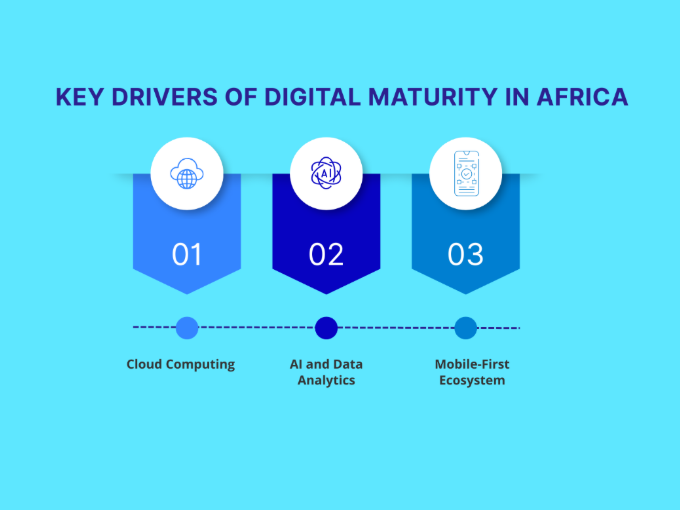
4.1 Cloud Computing
Cloud is the foundation of digital transformation. Approximately 88% of African organizations plan to increase their cloud investments, reflecting strong momentum.
Cloud adoption includes:
- 40% leveraging a trusted cloud to mitigate risks
- 36% adopting sovereign cloud solutions to support AI capabilities
Organizations should prioritize:
- Cloud-first strategies
- Scalable infrastructure to support AI and analytics
- Strong governance frameworks for cloud usage
4.2 AI and Data Analytics
AI is becoming a strategic necessity; however, its implementation remains uneven and often limited in scale.
Key challenges include:
- Skills shortages
- Fragmented data systems
- Infrastructure constraints
Collectively, these challenges create a gap between innovation and execution.
To unlock the full potential of AI, organizations should:
- Invest in data quality and governance
- Develop AI-related skills and expertise
- Scale successful AI use cases across the organization
4.3 Mobile-First Ecosystem
The mobile-first model is a major driver of Africa’s digital transformation, enabling rapid adoption of:
- Digital payments
- E-commerce
- Platform-based services
This approach has allowed many African markets to bypass traditional legacy systems and accelerate digital adoption.
Recommendation:
Organizations should design mobile-first solutions, leverage platform ecosystems, and prioritize accessibility and user-centric design.
5. Challenges Slowing Digital Maturity
Despite significant progress, several structural challenges continue to slow digital maturity:
- Skills Deficit: KPMG reports that 53% of organizations lack sufficient digital competencies to support transformation initiatives
- Technology Deficit: Digital infrastructure remains fragmented, particularly between urban and rural areas
- Data & Governance Issues: Organizations face fragmented data environments and weak governance frameworks
- AI Scaling Challenges: While many organizations invest in AI, scaling across the enterprise remains difficult
To overcome these barriers, organizations should:
- Invest in training and talent development
- Strengthen data governance frameworks
- Build scalable and standardized digital infrastructures
6. Opportunities: Africa’s Digital Leapfrog Potential
Africa presents strong growth potential across several key domains:
- Artificial Intelligence, with a projected CAGR of 23.4%
- Hybrid cloud, with an estimated CAGR of 26.9%
- Rapid expansion of digital ecosystems
Additionally, Africa benefits from structural advantages:
- A young, tech-savvy population
- A growing startup ecosystem
- Increasing international investment in technology
To capitalize on these opportunities, organizations should:
- Leverage emerging digital markets
- Invest in innovation hubs, incubators, and accelerators
- Build regional and global partnerships
7. The Future: Cross-Technology as a Strategic Imperative
Achieving digital maturity in Africa requires the seamless integration of multiple technologies into unified systems.
To succeed, organizations must:
- Combine AI, cloud computing, and data capabilities
- Strengthen cybersecurity resilience
- Develop scalable digital platforms
- Invest in talent and strategic partnerships
Organizations should adopt a holistic, enterprise-wide approach to technology:
- Technology must drive business transformation
- It should enable cross-functional collaboration
- It must continuously support innovation and scalability
Conclusion
Africa has moved past being an experimental region for digital technology to the point where it is beginning to move toward achieving strategic digital maturity. The key competitive advantage will arise from being able to integrate multiple technologies into a single coherent cross-technology platform rather than just adopting a single new technology.
The question is no longer “Should companies adopt digital technologies?” instead of, “How can companies leverage these technologies together to create sustainable value?” The organizations that will play leading roles in Africa’s digital future will be the ones that start taking action now.
It is time for companies to turn their digital vision into actual digital execution.
If you want to be positioned at the forefront of this transformation, then you must rethink your strategy, invest in integrating technologies, and create a fully joined up digital ecosystem.
Sources :
PwC : Africa Cloud Business Survey 2025: https://www.pwc.co.za/en/publications/africa-cloud-business-survey.html
Deloitte & Africa Financial Summit Report 2026 https://www.deloitte.com/fr/fr/about/press-room/barometre-industrie-financiere-africaine
KPMG : Global Tech Report 2026 https://kpmg.com/za/en/newsroom/press-releases/2026/01/global-tech-report-2026.html
Mordor Intelligence : Africa Digital Transformation Market Report : https://www.mordorintelligence.com/industry-reports/africa-digital-transformation-market
ITWeb : https://www.itweb.co.za/article/ai-scaling-gap-slows-africas-digital-transformation/DZQ587V8lmZqzXy2
TechCabal : insights sur AI et digital maturity en Afrique : Techcabal.com/2026/02/07/digital-maturity-report-afis/
Tech africa : https://tech.africa/pwc-africa-cloud-survey-2025/