
Companies from all over the globe have started competing based on how customers perceive their brands and interactions rather than what features each offer. In Africa, this shift is further complicated by rapid growth in access to fast internet, a young population, and significant disparities in or between access and service quality.
Internet usage in Africa has grown double that of the global average; however, 38% of the African continent was reported as having access to the internet as of 2024 versus 68% for the rest of the world. In the period from 2019 to 2022, the number of broadband users in Sub-Saharan Africa grew by more than 160 million people reflecting an 115% growth in internet users between 2016 and 2021, but millions are still left offline for several reasons.
Therefore, the problem becomes how can customer experience, which is recognized as one of the most significant factors driving growth across Africa, be translated by businesses into measurable growth?
The Rise of the African Digital Customer
One of the world’s fastest-growing consumer markets is in Africa. According to McKinsey & Company, an estimated 250 million Africans will become part of the consumer class by 2030 and help unlock over USD 3 trillion in consumer spending. The way consumers find, research, and buy products is dramatically changing as mobile phones and the internet develop.
At the end of 2023, Sub ‑Saharan Africa had an estimated 320 million mobile internet users, accounting for about 27% of the total population. This is expected to reach 37% by 2030.
In 2022, Sub ‑Saharan Africa had approximately 515 million mobile phone users (approximately 43% of the total population). Of this group, only 29% use mobile internet; therefore, there is a significant gap in usage.
Kenya and South Africa lead the way in digital payment usage. In 2024, an estimated 75.8% of adults in Kenya and 70.5% of adults in South Africa reported making a digital payment in the previous year.
The penetration of the internet is vastly different across the continent – for example, Morocco has one of the highest levels of internet penetration at approximately 91%, while large parts of Africa have much lower levels of access. Young people aged 15–24 represent the highest levels of internet access, with an estimated 53% of people in this age group using the internet in 2024 compared to approximately 34% of the total population.
As more customers connect digitally, their expectations for a smooth, fast, secure, and transparent customer experience will be influenced both by global platforms and by local digital leaders.
Recommendations
- Segment customers by digital readiness and adapt journeys for basic, intermediate, and advanced users.
Invest in mobile‑first design, as smartphones are the primary way Africans access the internet, not PCs.
- Use data (with consent) to map typical journeys and pain points for key segments such as youth, informal workers, and SMEs.
Why Customer Experience Drives Growth in Africa
The customer experience (CX) is a significant part of growth; CX has some bearing on whether customers try a brand/service, stay with it and increase their spending over time. In many competitive African markets, where alternative sources of supply are just a touch away, and where consumers have little trust in the market, consumer experience is often the differentiating factor for selection.
According to the World Bank, there were an additional 191 million Africans who made or received digital payments in the period 2014 – 2021, which results in significant new digital touch points where the quality of experience will drive usage moving forward.
McKinsey estimates that the total revenue to large companies operating in Africa, by 2030, would be over $550 billion if companies implemented more aggressive strategies that include a more significant emphasis on customer-centricity.
In SA, CX research commissioned by several large companies that provides evidence that a significant percentage of consumers would pay a premium in many categories if they knew they would receive an outstanding customer experience.
From an operational perspective, companies that have integrated digital and CX capabilities are able to differentiate themselves from their less integrated competitors, as companies with poor-performing CX-performance indicators also tend to report limited digital integration into customer journeys and report fragmented customer interactions. However, companies that have redesigned their customer journeys and utilized AI or analytics to personalize customers’ experiences have seen more rapid adoption, better engagement, and lower customer churn.
Recommendations
- Redesign sales and service journeys to reduce steps, waiting times, and repeated information requests. Aim to cut effort by at least 30–50%.
- Introduce simple loyalty programs and transparent rewards that recognize consistent usage and good customer history.
- Track churn and complaints closely and treat them as early warning signals to fix broken experiences before they damage growth.
Gaps, Challenges and What Needs to Change
Although advancements have been made, large gaps still exist within Africa’s full digital customer experience potential via the Internet and mobile networks. Many users who can connect to mobile networks do not use these services due to affordability, lack of ability, and lack of security confidence.
In 2022, 59% of the total population of Sub-Saharan Africa (approximately 680 million people) were covered by a mobile network but did not have access to mobile internet services. By 2024, it was anticipated that only 38% of Africans would have access to the Internet, therefore making Africa the least connected continent in the world. Disparities exist between women’s usage of the Internet versus men’s; older adults’ usage versus younger adults; and urban areas versus rural areas. Individuals living in lower wealth situations did not have Internet usage and, therefore, have a much lower digital literacy rate.
Thus, in instances of a customer experience involving multiple channels to interact, complex user experiences and/or important levels of data use, large groups of potential customers may not be able to use them nor have the desire to do so. Similarly, organizations/companies are challenged as they frequently do not have the required skills to provide an effective customer experience; have data and system silos; and often have an organizational culture that is focused on short-term sales rather than creating long-term relationships.
Recommendations
- Design for low bandwidth and low spec devices: light apps, USSD or WhatsApp journeys, and offline options where possible.
- Offer multilingual support and simple tutorials or in app guidance to build confidence among first time digital users.
- Invest in CX and digital skills through training, partnerships, and centers of excellence to build internal capabilities, not just buy technology.
Practical CX Priorities for African Businesses
To make customer experience a real growth engine, African companies need a practical, focused agenda that links CX directly to business outcomes.
Key priorities include:
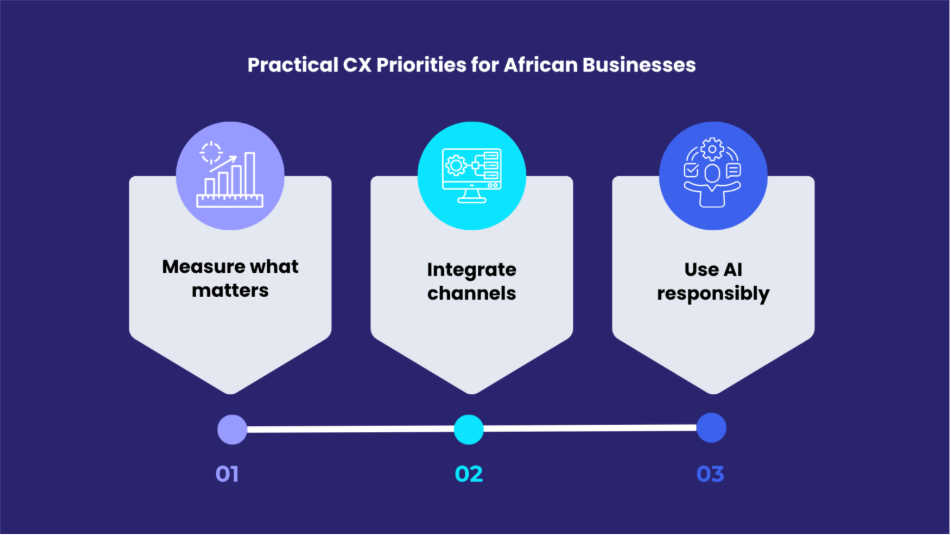
- Measure what matters: track satisfaction, NPS, digital adoption and task completion for key journeys (onboarding, payments, claims, support), and review them at executive level.
- Integrate channels: ensure consistency between branches, call centers, apps, and social media so customers can start in one channel and continue in another without repeating themselves.
- Use AI responsibly: deploy chatbots and assistants to extend 24/7 service and personalize offers, while maintaining clear human escalation and respecting privacy.
Real world examples show that African organizations, using data driven personalization and simplified digital journeys achieve higher growth and better customer loyalty. As e- commerce in markets like South Africa grows from around 6% of total retail to an expected 10% of spend, the brands that win will be those that offer the easiest, safest, and most enjoyable experiences.
Recommendations
- Start with one or two critical journeys (for example, opening an account, ordering online, or lodging a complaint) and redesign them end‑to‑end with real customer input.
- Build a small, cross‑functional CX squad (business, IT, operations, frontline) to make improvements and test latest ideas quickly.
- Communicate clearly and proactively about changes, outages, and new features to build trust and reduce customer anxiety.
- Conclusion:
Africa’s digital transformation is unlocking millions of new customer relationships every year, but the brands that will grow fastest are those that offer simple, human, trusted experiences across every touchpoint. With internet use still at only 38% and mobile internet penetration at 27% in Sub-Saharan Africa, the opportunity is not just to reach more people, but to serve them better and more inclusively once they are connected.
At Nexfing, we help African organisations turn customer experience into measurable growth by, simplifying digital interactions and using data and AI to personalise at scale while keeping experiences clear and human.
Sources :
Connecting Africa : https://www.connectingafrica.com/4g-networks/4g-will-outpace-3g-by-2030-in-sub-saharan-africa-gsma
https://www.connectingafrica.com/digital-inclusion/mwc-kigali-2023-closing-the-mobile-usage-gap-gsma
World Bank : https://www.worldbank.org/en/results/2024/01/18/digital-transformation-drives-development-in-afe-afw-africa
https://www.mckinsey.com/capabilities/operations/our-insights/where-is-customer-care-in-2024
https://www.mckinsey.com/capabilities/quantumblack/our-insights/leading-not-lagging-africas-gen-ai-opportunity
BCG : https://www.bcg.com/publications/2024/africa-winning-the-tech-race-in-africa-lessons-from-digital-natives
Deloitte digital : https://www.deloittedigital.com/de/en/insights/research/deloitte-cx-study-2025.html
International Telecommunication Union : https://www.itu.int/dms_pub/itu-d/opb/ind/D-IND-SDDT_AFR-2025-PDF-E.pdf
NGF Digital repository : https://ngfrepository.org.ng:8443/jspui/bitstream/123456789/7373/1/88244627_221024-Digital-Africa-Index-EN-2.pdf
Ecofin agency : https://www.ecofinagency.com/news-digital/0506-47164-africa-s-internet-growth-outpaces-world-but-gaps-in-access-remain-deep
Ghana Chamber of telecommunications :https://www.telecomschamber.org/industry-news/mobile-internet-access-still-limited-in-africa-millions-remain-offline/
Data Cup :https://datacup.io/en/blog/datacup-1/how-has-mobile-internet-penetration-developed-in-africa-40