
What if Africa’s biggest economic opportunity was not oil, mining, or even traditional infrastructure, but intelligent systems capable of helping organizations make faster, smarter, and more strategic decisions?
Across Africa, artificial intelligence (AI), machine learning, predictive analytics, and intelligent automation are transforming industries ranging from finance and agriculture to healthcare and public administration. Intelligent systems are no longer limited to operational support; they are becoming strategic decision-making tools that improve efficiency, reduce risks, and accelerate economic growth.
According to, generative AI alone could unlock between $61 billion and $103 billion in annual economic value across Africa if deployed at scale. Meanwhile, Africa’s AI market is projected to grow from approximately $4.5 billion in 2025 to $16.5 billion by 2030, with an annual growth rate exceeding 27%.
But how exactly are intelligent systems enhancing human decision-making across Africa’s key industries?
This article explores :
- The growth of Africa’s AI economy
- How intelligent systems are transforming finance, agriculture, healthcare, and public services
- The major challenges limiting AI adoption
- Strategic recommendations for organizations and governments
Africa’s AI Economy Is Growing Rapidly
Africa is becoming one of the world’s fastest-growing digital markets. Rising mobile penetration, a young population, and expanding digital infrastructure are accelerating the adoption of intelligent technologies.
According to Mastercard’s AI whitepaper, Africa’s AI market is expected to nearly quadruple by 2030, reaching approximately $16.5 billion. Several countries including Morocco, Kenya, South Africa, Nigeria, Egypt, and Rwanda are investing heavily in AI strategies and digital transformation programs.
The continent’s digital economy is also expanding rapidly. Mastercard estimates Africa’s digital payments economy could reach $1.5 trillion by 2030. This creates ideal conditions for intelligent systems because digital transactions generate valuable data that can improve analytics, forecasting, personalization, and operational efficiency.
In addition, McKinsey reports that more than 40% of African organizations are already experimenting with or deploying AI technologies.
Why this matters for decision-making
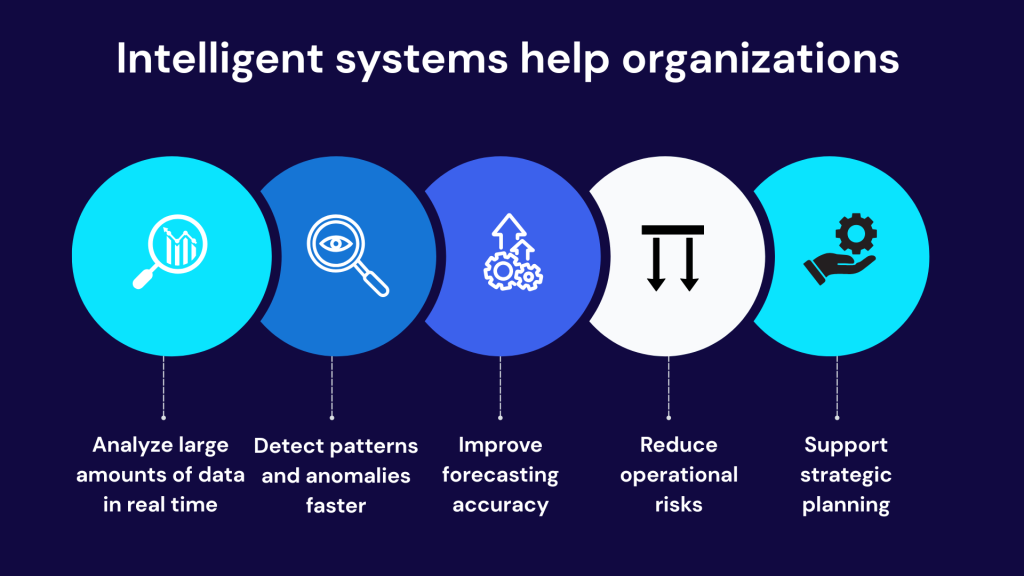
Intelligent systems help organizations:
- Analyze large amounts of data in real time
- Detect patterns and anomalies faster
- Improve forecasting accuracy
- Reduce operational risks
- Support strategic planning
Rather than replacing humans, these systems augment human expertise and improve the quality of decisions.
Recommendations
To accelerate AI-driven growth across Africa:
- Governments should invest in digital infrastructure and cloud ecosystems
- Universities should strengthen AI and data science education
- Businesses should integrate AI gradually into decision-making processes
- African startups should focus on solving local operational challenges through intelligent technologies
How Intelligent Systems Are Transforming African Financial Services
Financial services are among the sectors benefiting the most from intelligent decision-making systems in Africa.
Historically, millions of Africans lacked access to traditional banking services due to limited credit histories, geographical barriers, and administrative complexity. Intelligent systems are now helping financial institutions overcome these limitations.
AI-powered credit scoring
Traditional banks rely heavily on formal financial histories to evaluate loan applications. However, many Africans work in informal sectors and lack conventional banking records.
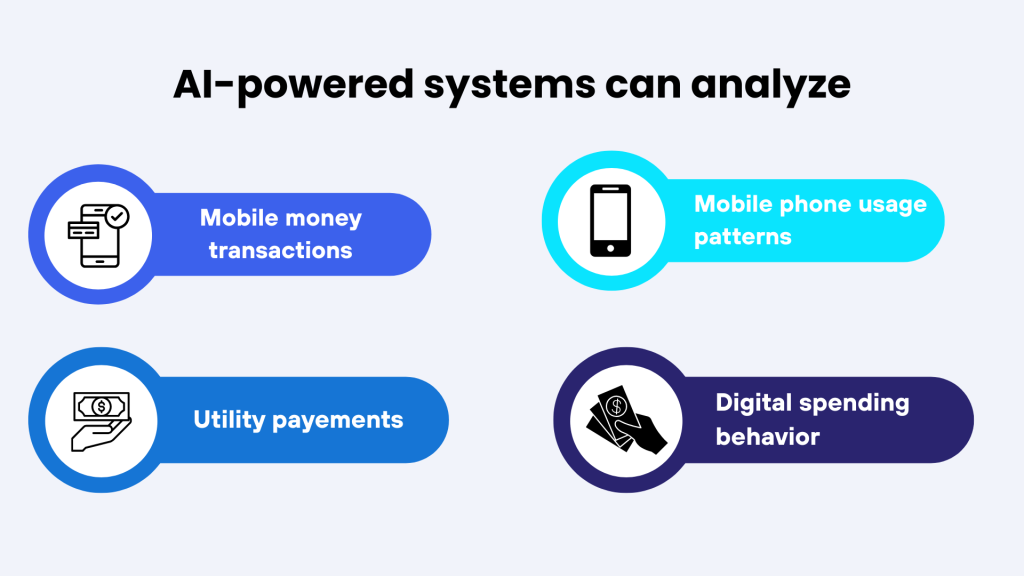
AI-powered systems can now analyze:
- Mobile money transactions
- Utility payements
- Digital spending behavior
- Mobile phone usage patterns
This allows financial institutions to make faster and more inclusive lending decisions.
According to McKinsey, financial services represent one of Africa’s largest AI opportunities because of the sector’s massive data potential.
Fraud detection and risk management
Machine learning systems can analyze thousands of transactions in real time and identify suspicious behavior much faster than traditional manual systems.
This improves:
- Fraud prevention
- Cybersecurity monitoring
- Compliance management
- Risk analysis
African banks are also increasingly using AI chatbots and predictive systems to improve customer experiences and operational efficiency.
Reuters recently reported that African banking revenues exceeded $100 billion for the first time, supported partly by rapid digital banking adoption.
Recommendations
To strengthen intelligent financial systems across Africa :
- Banks should invest in AI-powered fraud detection tools
- Governments should modernize digital financial regulations
- Fintech companies should prioritize financial inclusion solutions
- Organizations should improve cybersecurity and data governance frameworks
Intelligent Agriculture Is Improving Food Security
Agriculture remains one of Africa’s largest economic sectors, employing a significant share of the continent’s workforce. Yet farmers continue to face major challenges including climate change, water scarcity, pests, and unpredictable weather conditions.
Intelligent systems are helping farmers make better operational decisions through predictive analytics and real-time monitoring.
AI-powered farming systems
Intelligent agricultural technologies can analyze:
- Satellite imagery
- Soil conditions
- Weather patterns
- Crop health indicators
These systems help farmers:
- Predict optimal planting periods
- Detect crop diseases early
- Optimize irrigation
- Reduce fertilizer waste
- Improve harvest planning
According to several AI and agriculture studies, predictive farming systems can significantly reduce crop losses and improve productivity in climate-sensitive regions.
Smart logistics and agricultural platforms
African agritech startups are also improving operational efficiency through intelligent logistics systems.
For example:
- Digital platforms connect farmers to tractor services
- Predictive systems optimize supply chains
- AI-powered marketplaces improve price transparency
These technologies reduce operational inefficiencies and support more informed agricultural decision-making.
Recommendations
To scale intelligent agriculture in Africa:
- Governments should subsidize digital farming technologies
- Telecom companies should improve rural internet access
- Agricultural cooperatives should invest in data-sharing platforms
- Startups should develop localized AI solutions adapted to African farming realities
AI Is Reshaping Healthcare Decision-Making
Healthcare systems across Africa face major challenges linked to infrastructure shortages, limited medical staff, and unequal access to care.
Intelligent systems are helping healthcare providers improve diagnostics, patient management, and operational efficiency.
Faster diagnostics and predictive healthcare
AI-powered systems can assist doctors by:
- Analyzing medical images
- Predicting disease outbreaks
- Supporting treatment recommendations
- Improving patient prioritization
These technologies are particularly valuable in rural or underserved regions where medical expertise may be limited.
Intelligent logistics and medical delivery
One of Africa’s most recognized intelligent healthcare innovations is Zipline’s drone delivery system in Rwanda and Ghana.
The company uses intelligent logistics systems to deliver:
- Blood supplie
- Vaccines
- Emergency medications
This significantly reduces delivery times and improves emergency healthcare responsiveness.
Healthcare data and patient management
Intelligent digital systems also improve:
- Patient tracking
- Healthcare fraud prevention
- Medical record management
- Resource allocation
This helps healthcare institutions make more informed operational decisions while improving service quality.
Recommandations
To improve intelligent healthcare adoption :
- Governments should strengthen healthcare data systems
- Hospitals should invest in AI-assisted diagnostics
- Public-private partnerships should support digital healthcare innovation
- Organizations must prioritize ethical AI and patient privacy protection
Intelligent Public Services and Governance
Governments across Africa are increasingly exploring how intelligent systems can improve public administration and policymaking.
AI-powered systems can help governments:
- Analyze public data faster
- Improve transportation planning
- Optimize resource allocation
- Enhance tax administration
- Reduce administrative delays
Countries such as Morocco, Kenya, Rwanda, and South Africa are actively developing national AI strategies.
Smart governance and data-driven policies
Intelligent systems allow governments to make more evidence-based decisions by analyzing large amounts of public-sector data in real time.
This improves:
- Urban planning
- Infrastructure development
- Emergency response systems
- Public service efficiency
However, strong governance remains essential to ensure ethical AI deployment.
Recommendations
To strengthen AI governance in Africa:
- Governments should establish national AI regulations
- Public institutions should improve data quality and interoperability
- Countries should collaborate on continental AI standards
- Organizations should prioritize transparency and ethical AI frameworks
The Major Challenges Slowing AI Adoption in Africa
Despite enormous opportunities, Africa still faces significant barriers to large-scale intelligent system adoption.
Infrastructure limitations
Reliable internet access, electricity, and cloud infrastructure remain inconsistent across several regions.
Without stable digital infrastructure, intelligent systems cannot scale effectively.
Skills shortages
AI requires expertise in :
- Data science
- Cybersecurity
- Software engineering
- Machine learning
- Digital governance
Many African countries still face shortages of highly qualified AI professionals.
Data accessibility and quality
AI systems depend heavily on reliable and representative datasets. Fragmented or poor-quality data reduces the effectiveness of predictive systems.
Ethical and cybersecurity risks
Organizations must also address concerns related to:
- Algorithmic bias
- Privacy protection
- Cybersecurity threats
- Data misuse
- Ethical AI governance
Brookings Institution research emphasizes that infrastructure inequality and data limitations remain major AI barriers across Africa.
Recommendations
To overcome these barriers:
- Governments should increase investment in digital infrastructure
- Universities should expand AI training programs
- Businesses should improve data governance practices
- Regional cooperation should support knowledge-sharing and innovation ecosystems
Africa’s Intelligent Future Depends on Human-Centered Innovation
Africa’s AI transformation is still in its early stages, but the momentum is accelerating rapidly.
Intelligent systems are already helping organizations:
- Make faster decisions
- Improve operational efficiency
- Reduce risks
- Enhance customer experiences
- Strengthen strategic planning
What makes Africa’s situation unique is that intelligent systems are often helping industries leapfrog traditional development stages. Mobile banking, AI-powered agriculture, intelligent logistics, and digital healthcare demonstrate how innovation can directly address structural challenges.
According to McKinsey, Africa could unlock more than $100 billion annually from generative AI alone if adoption barriers are addressed effectively.
But technology alone is not enough.
The future of intelligent decision-making in Africa will depend on :
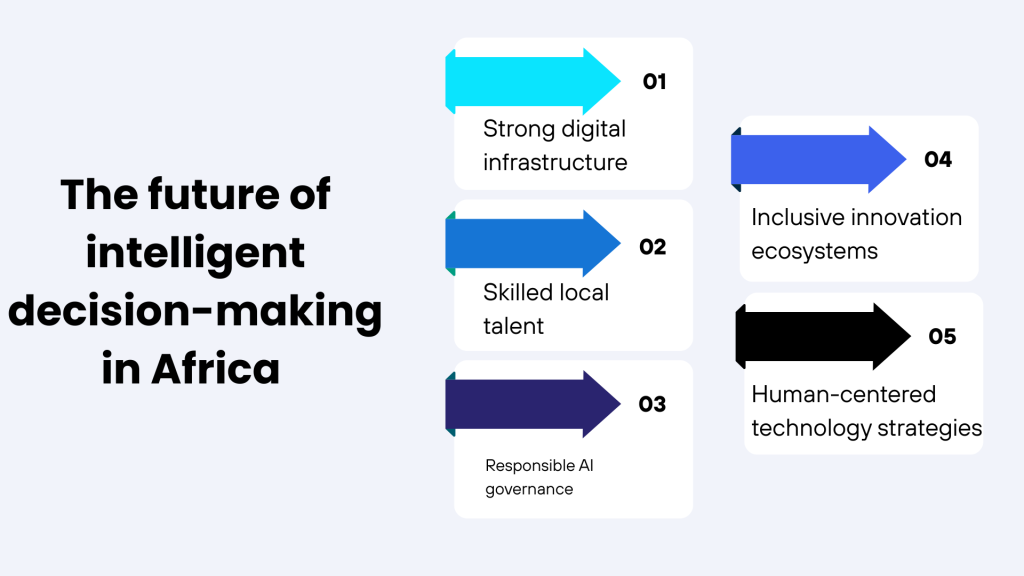
- Strong digital infrastructure
- Skilled local talent
- Responsible AI governance
- Inclusive innovation ecosystems
- Human-centered technology strategies
Ultimately, intelligent systems are not replacing human intelligence, they are enhancing it.
Organizations that successfully combine human expertise with intelligent technologies will be better positioned to innovate, compete, and grow in Africa’s rapidly evolving digital economy.
Sources :
McKinsey :https://www.mckinsey.com/capabilities/quantumblack/our-insights/leading-not-lagging-africas-gen-ai-opportunity
McKinsey :https://www.mckinsey.com/featured-insights/week-in-charts/africas-gen-ai-potential
Bloomber glaw :https://news.bloomberglaw.com/artificial-intelligence/mckinsey-sees-gen-ai-adding-up-to-100-billion-to-africa-economy
Mastercard: https://www.mastercard.com/news/eemea/en/newsroom/press-releases/en/2025-1/august/ai-in-africa-to-top-16-5b-by-2030-mastercard-explores-path-for-continued-digital-transformation/
Coingeek: https://coingeek.com/africa-ai-market-to-hit-16-5b-by-2030-report/
Africa business communities: https://africabusinesscommunities.com/tech-24/ai-in-africa-to-top-%2416.5b-by-2030-mastercard-report/
Data centres Africa: https://datacentresafrica.com/news-details-7128/
The baobab network: https://thebaobabnetwork.com/africas-ai-inflection-point-adopter-or-architect/
Medium: https://medium.com/%40kondwani0099/africas-ai-revolution-a-realistic-path-to-1-5-trillion-by-2036-2595edf4ae56
ITWeb Africa: https://itweb.africa/article/africas-ai-market-to-soar-to-165-billion-by-2030-says-mastercard/rxP3jqBEo6YMA2ye