
Innovating Without Losing Data Control
The Big Challenge of Digital Banking
In a world where technological innovation capacity defines competitive leadership, African financial institutions face a strategic dilemma: rapidly adopt powerful cloud and AI technologies to remain competitive, while complying with increasingly strict regulatory frameworks on data control and localization.
On one side, the public cloud offers phenomenal agility to accelerate digital projects, support massive data loads, and integrate advanced AI services. On the other, African banking regulators impose rules on data residency, sectoral compliance, and cybersecurity to protect sensitive client information.
The challenge is clear: how to reconcile rapid technological innovation, data sovereignty, and regulatory compliance within a secure cloud model?
1. Overview of the Cloud in Africa and Sovereignty Challenges
1.1. Cloud Adoption: African Reality
Digital transformation in Africa is no longer a projection: it is a measurable reality. According to the PwC Africa Cloud Business Survey, more than 80% of African companies have already migrated all or a large part of their operations to the cloud, and 61% plan to move all their digital assets to the cloud within the next two years.
A McKinsey report indicates that on average 45% of African companies’ workloads are now in the public cloud, with a significant proportion of IaaS, PaaS, and SaaS services already adopted. These figures confirm a real adoption momentum: Africa is no longer a spectator of cloud transformation, it is becoming a growing player. The banking sector, in particular, is at the heart of this movement: the digitalization of client services (mobile banking, electronic payments, open API support) relies on scalable and agile cloud platforms.
However, this massive adoption highlights a critical challenge: data localization, a regulatory and competitive imperative.
Nexfing Recommendation
It is essential to map workloads according to their criticality (client accounts, transactional data, compliance logs) to define whether they must remain under sovereignty or can be outsourced to the public cloud.
1.2. Specific African Challenges
Despite this dynamism, Africa faces particular obstacles, according to McKinsey & Company :
- Regulatory constraints: Data protection laws in several African countries require sensitive information to be stored and processed locally.
- Limited infrastructure: Even though significant initiatives are emerging, the density of regional datacenters remains low.
- Shortage of specialized skills: Finding and retaining cloud/DevOps/AI talent remains a major challenge.
The combination of rapid cloud adoption growth and strong regulatory constraints requires a cloud strategy designed for Africa, which is neither fully public cloud nor fully on-premise, but an agile and controlled architecture.
1.3. Why Data Sovereignty is Strategic
According to IBM: Data sovereignty is defined as the fact that data is subject to the legal frameworks of the place where it is generated, stored, or processed. It is a fundamental notion for financial institutions handling highly sensitive information.
Key Difference:
- Resident data: physically stored in a given territory.
- Data sovereignty: complete legal governance imposing how this data must be managed in that territory.
2. What is Sovereign Cloud?
According to IBM, The sovereign cloud is a cloud infrastructure model that allows an organization to retain full control over its data, compliant with local laws, while benefiting from the scalability and advanced cloud services.
In sectors like banking, where regulatory compliance, confidentiality, and data integrity are absolute, sovereign cloud is not a luxury but a strategic requirement. It allows controlled outsourcing while retaining legal responsibility for sensitive data.
CIO Africa: Sovereignty does not only concern the physical location of data, but also complete governance over its lifecycle (storage, processing, governance, access, audit). In many African countries, regulations are emerging to mandate the localization of sensitive data (banking, finance, healthcare).
In this context, global hyperscalers (AWS, Microsoft, Google) are gradually deploying local cloud zones and partnerships with African operators (e.g., AWS + Orange in Morocco and Senegal) to meet these compliance requirements.
Sovereignty is no longer a “check-box” but a regulatory and competitive trust criterion. A bank able to demonstrate that its sensitive data remains under strict legal control gains a strategic advantage with clients, regulators, and partners.
Nexfing Recommendation
Adopt a “sovereign by design cloud strategy”: integrate localization, encryption, and governance policies from the architecture design phase, rather than adding them at the project’s end.
3. Definition, Principles, and Challenges of Hybrid Architectures
3.1. Hybrid Architecture Explained Simply
A hybrid architecture is an approach combining:
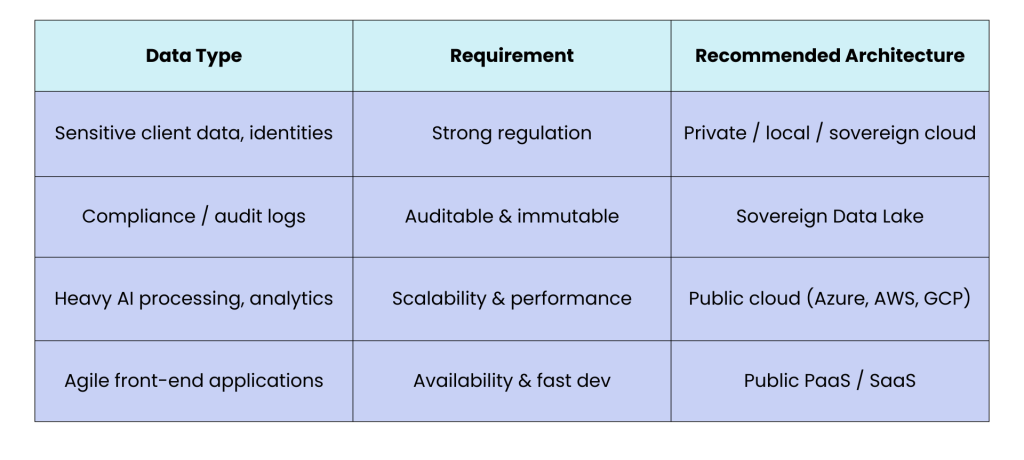
- A private or sovereign cloud for critical workloads (banking data, identities, compliance logs)
- A public cloud for innovation, scalability, and performance-oriented services (AI, analytics, microservices)
- Optionally, an edge computing layer for real-time performance
The key principle is to make these environments coexist via intelligent orchestration, without siloing IT.
Hybrid is not simply a juxtaposition of IT environments: it is an integration platform that must ensure:
- Unified security and governance
- Interoperability of services
- Observability and continuous compliance
This approach refutes the notion that cloud innovation requires “total dependence on hyperscalers.”
Nexfing Recommendation
Build orchestration layers based on secure APIs, decoupled microservices, and data flows classified according to automated policies (classification, encryption, anonymization).
3.2. Data Classification: Foundation of Sovereignty
In practice, data classification is essential to determine hosting location:
4. Technical Approaches and Integration Models
4.1. Interoperability and Orchestration
The orchestration layer is the technical heart of hybrid architecture. It ensures that workloads driving digital transformation (API, analytics, data pipelines) interact without compromising sovereignty policies.
Technical Best Practices
- Centralized API Gateway with access control based on policy engines (RBAC, ABAC)
- Data Fabric for a unified metadata repository
- Service catalog defining SLAs for each cloud zone
- Infrastructure as Code (IaC) to standardize deployments
4.2. Automated Compliance and Integrated Governance
To ensure compliance, the architecture must integrate automated control loops continuously checking:
- Data localization
- Access and permissions
- Journaling & auditability
- Transformation traceability
Solutions like Cloud Security Posture Management (CSPM), Data Loss Prevention (DLP), and Governance Risk & Compliance (GRC) connected in DevSecOps pipelines reinforce operational sovereignty.
5. Concrete Use Cases in Banking
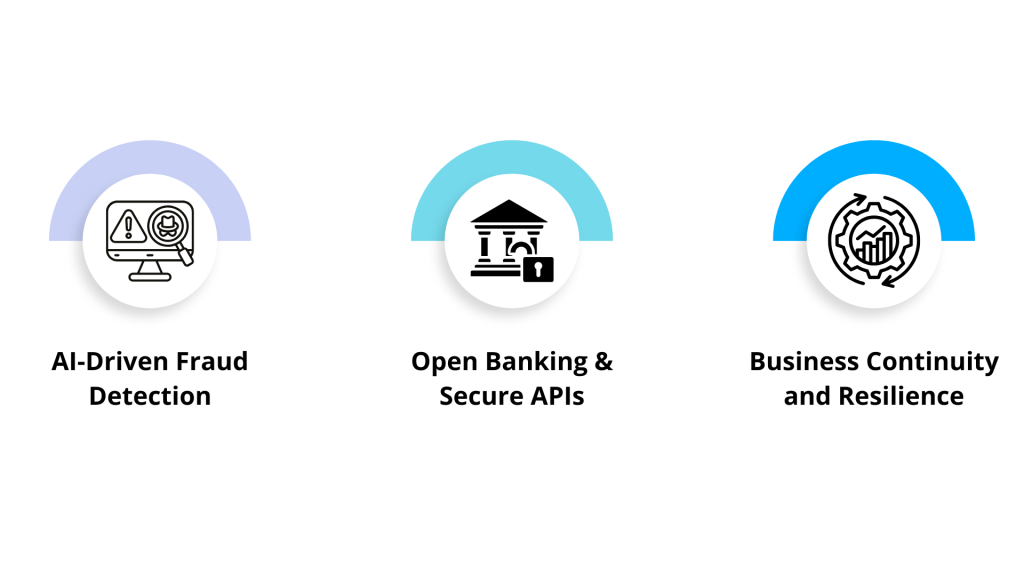
5.1. AI-Driven Fraud Detection
African banks process millions of transactions daily. A hybrid architecture enables:
- Indexing and storing critical transactions in a sovereign cloud
- Running AI models on the public cloud for large-scale analysis
- Sending alerts to on-premise sovereign systems for human arbitration
This model reduces analysis latency while keeping sensitive data under control.
5.2. Open Banking & Secure APIs
Open Banking requires controlled API exposure to external partners (fintechs, PSP). In a hybrid model:
- API management is orchestrated via a secure gateway
- Sensitive data never leaves the sovereign zone beyond regulatory limits
- Innovative services can consume aggregated anonymized data on the public cloud
5.3. Business Continuity and Resilience
A hybrid architecture allows implementing a robust disaster recovery strategy: in case of a main system outage, strategic services can be redirected to public cloud environments while remaining compliant with certified recovery policies.
General Strategic Recommendations
- Classify your data and workloads now according to criticality and sovereignty constraints.
- Implement a unified governance platform integrating automated rules, continuous audit, and real-time visibility.
- Invest in native cloud API orchestration to ensure interoperability across hybrid environments.
- Adopt a DevSecOps approach to integrate security, compliance, and automation from design.
- Consider multi-cloud to reduce vendor lock-in risk and gain flexibility.
To sum up, Can we innovate without losing data control ?
The answer is yes, but not without a solid technical strategy and governance. African banks must design intelligent hybrid architectures, where sovereignty is not a barrier to innovation but a differentiating asset. Through rigorous classification, modern orchestration, and automated governance, it is possible to combine innovation agility and end-to-end regulatory compliance, the cornerstone of a competitive platform bank.
Hook Question: Is your institution ready to leverage the potential of cloud and AI while retaining full control over your sensitive data?
At Nexfing, the approach is simple yet powerful: design tailored hybrid cloud architectures integrating data sovereignty, banking compliance, and advanced AI capabilities. We help financial institutions navigate complex regulatory environments, optimize time-to-market with automated cloud orchestration, and strengthen operational resilience.
Discover how Nexfing can transform your technology platform. Contact us for a strategic assessment and personalized hybrid architecture plan.
Sources :
Pwc : https://www.pwc.co.za/en/publications/africa-cloud-business-survey.html
McKinsey & Company : https://www.mckinsey.com/capabilities/tech-and-ai/our-insights/africas-leap-ahead-into-cloud-opportunities-and-barriers
CIO Africa : https://cioafrica.co/unpacking-africas-shifting-data-cloud-and-sovereignty-landscape/
IBM : https://www.ibm.com/think/insights/sovereign-cloud-on-a-global-scale
https://www.ibm.com/think/topics/data-sovereignty
Microsoft : https://news.microsoft.com/source/emea/features/microsoft-invests-zar-5-4bn-in-south-africa/