
Africa is entering a new era of instant payment systems (IPS), now operational in 36 African countries, processed 64 billion transactions worth nearly $ 1,980 billion in 2024, with an average annual growth of +35% in volume and +26% in value between 2020 and 2024, according to Agence EcoFin.
This leap, fueled by financial inclusion, banking digitization, and mobile adoption, poses a dual major challenge for financial institutions:
- Client fluidity: users demand fast, simple, frictionless payments.
- Enhanced security: the multiplication of instant flows increases exposure to cyber threats and real-time fraud.
According to Deloitte, in its “Revolution of AI in Secure and Optimized Transaction Payments” report, AI is now the most powerful technological response to these paradoxical expectations: it promises to examine millions of signals in milliseconds, anticipate risks, and adapt to variable contexts without deteriorating the user experience.
In this promising yet risky landscape, financial institutions face a major question: how to guarantee a smooth customer experience while ensuring enterprise level security in the face of increasingly sophisticated and rapid attacks?
The answer: smart payments powered by Artificial Intelligence.
To structure the thinking and dive deeper into each aspect, the article will successively cover:
- The context of digital and instant payments in Africa and globally
- Major technical challenges posed by security and fluidity
- The three pillars of AI driven smart payments
- The balance between customer experience and enhanced security
1. Global Context of Digital and Instant Payments
Rise of Instant Payments
In Africa, according to Agence EcoFin: 36 operational systems processed more than 64 billion transactions in 2024, representing nearly $2,000 billion in value. This critical mass exposes banks and fintechs to strong security pressure, as the near real-time transfer tests detection systems in under a second.
Nexfing Recommendation:
Invest in AI platforms capable of processing massive data streams continuously, adopting event driven architectures to reduce latency and support realtime analysis.
2. Global Adoption of AI in Payments :
According to the McKinsey Global Payments Report 2025, AI accelerates efficiency and fraud detection while adapting transaction scoring in real time. AI is redefining the very concept of smart payments, integrating behavioral and contextual signals into every decision.
This trend aligns with broader research showing exponential growth in AI use in financial services to enhance cybersecurity, automate workflows, and improve decision making.
Nexfing Recommendation:
Go beyond static rules toward adaptive scoring models, trained on transactional and behavioral variables.
3. Impact of AI on Cybersecurity and Fraud Models
Malicious actors are also using AI to automate, personalize, and amplify attacks. The Microsoft Security Blog highlights the emergence of fraud strategies based on advanced AI techniques, modernizing identity theft and deception vectors.
At the same time, IBM’s analysis of AI in banking finds that 61% of bank executives see fraud risk detection as the biggest business value driver for AI, with cybersecurity not far behind. This dual dynamic—AI-fueled fraud on one side, AI defense on the other—creates intense technological competition.
Nexfing Recommendation:
Integrate adaptive fraud detection mechanisms powered by AI, which continuously learn from emerging patterns and identify weak signals before they become major incidents.
4. The 3 Pillars of AI Driven Smart Payments
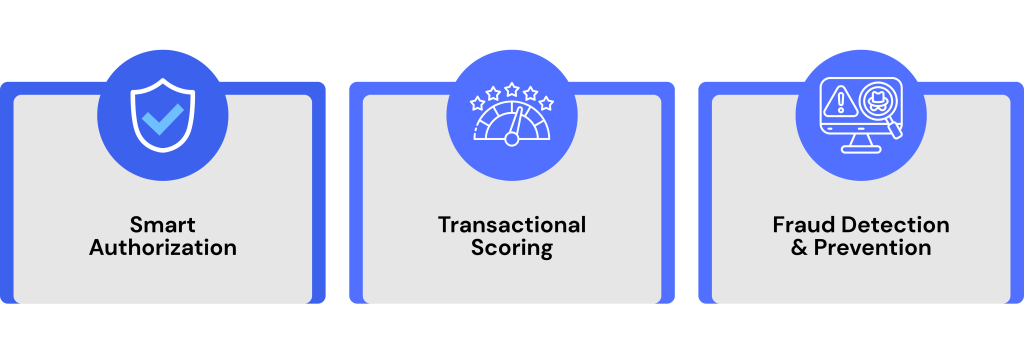
To optimize security and acceptance rates, AI activates three critical levers in real time:
- AI for Fraud Prevention :
Traditionally, antifraud measures relied on fixed rules (e.g., block any transaction above a threshold). Today, AI analyzes thousands of signals in milliseconds, such as:
• Geolocation of the cardholder
• Transaction history
• Device behavior
• Purchase typology
This rich context makes it possible to distinguish legitimate behavior from fraudulent patterns, even when IP or data is falsified.
GSMA : On the African continent, where mobile fraud costs more than $1 billion annually and slows the adoption of digital services.
- Intelligent Transaction Scoring:
Every payment receives a dynamic risk score based on dozens of signals (IP, device, geolocation, frequency, history, etc.).
• Low risk: automatic authorization
• Medium risk: adaptive challenge
• High risk: block or deeper review
This adaptive model reduces risk while optimizing acceptance rates and maintaining high security.
Nexfing Recommendation:
Use weighted scoring that incorporates continuous feedback from fraud incidents to adjust decision thresholds in real time.
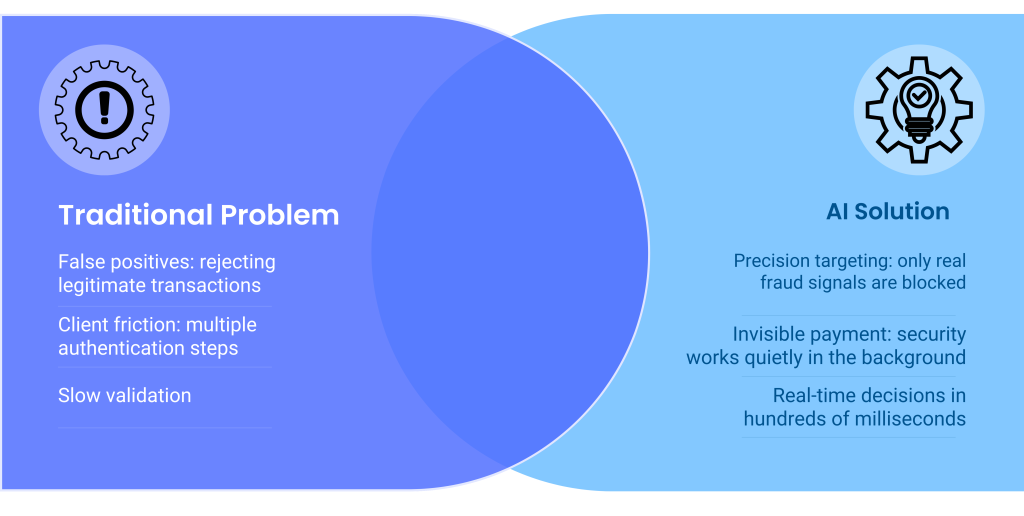
The advantage? A reduction in false positives, which frustrate clients and cost merchants lost sales.
- Optimized Authorization & Reduction of False Positives :
The role of AI is not only preventive : it is educational.
AI can contextualize a transaction and help build the issuer’s (bank’s) confidence to approve a payment, even when unusual signals are detected.
This translates into higher acceptance rates without compromising network security.
In a market characterized by high-volume instant transactions such as Africa, this is a strategic game-changer.
5. The Challenge of Instant Payments:
Agence EcoFin: With African IPS processing trillions of dollars in less than 10 seconds per transaction, every millisecond counts. A fraudster can empty an account faster than a manual process can react. AI makes complex decisions in less than 500 milliseconds by cross-referencing behavioral and historical vectors.
6. Balancing Customer Fluidity and Enhanced Security
The winning formula is based on a simple principle: risk-based authentication (RBA).
Rather than applying uniform security barriers (which frustrate 90% of legitimate users), the system becomes invisible for secure transactions and only intervenes when there is genuine doubt.
This paradigm enables :
• Frictionless journeys for the majority of payments,
• Intelligent barriers only when necessary,
• A seamless customer experience compatible with the demand for instant payment.
7. Concrete Benefits: Problem vs AI Solution
8. Perspectives, Risks & Best Practices:
Governance and AI Oversight
According to a PwC Responsible AI Survey, adopting AI requires a robust governance framework to prevent incidents linked to poorly controlled models.
Nexfing Recommendation:
Establish a responsible AI governance framework aligned with IT, security, compliance, and feedback loops to continuously refine operational outcomes.
9. General Recommendations for Banks and Financial Institutions
• Adopt AI at the heart of risk architecture
The integration of AI models for fraud detection, dynamic scoring, and adaptive authentication must be considered from the outset when developing payment infrastructures.
• Focus on real-time monitoring
Instant payments require complete and immediate visibility into transaction flows to detect anomalies before they materialize.
• Promote continuous model learning
Fraud patterns evolve rapidly; systems must be able to respond by adapting their models without frequent manual intervention.
• Educate and empower users
Security is not just about technology: raising customer awareness of risks and best practices reinforces the effectiveness of technical measures.
• Implement robust AI governance
Ensure that AI models are audited, transparent, and compliant with local and international ethical and regulatory standards.
• Collaborate with external experts
Institutions that lack internal capabilities can rely on specialized partners to accelerate integration with agility.
Africa stands at the center of a digital payment revolution. The rise of instant payment systems demands an approach that sacrifices neither security nor speed. AI plays the role of the ultra-trained sentinel: observing, anticipating, preventing, and enabling users to enjoy a smooth, secure, and transparent experience.
Are you looking to transform your payment systems to make them both ultra-fast and inherently secure?
At Nexfing, our expertise covers AI applied to smart payments: dynamic scoring, real-time behavioral detection, and adaptive authentication. Our solutions reduce false positives and ensure a smooth customer experience.
Contact us for a personalized assessment of your payment architecture and discover how Nexfing can secure your instant payments while improving the customer experience.
Sources :
Agence EcoFin : https://www.agenceecofin.com/actualites/1411-133365-en-afrique-les-systemes-de-paiement-instantane-ont-traite-1980-milliards-en-2024
PWC : https://www.pwc.com/us/en/tech-effect/ai-analytics/responsible-ai-survey.html