
Introduction: The New Strategic Challenge for African Financial Institutions
The African banking sector is currently undergoing an unprecedented transformation. Between the rise of mobile banking, the growing adoption of digital financial services, increasing competitive pressure from fintechs, and constantly evolving regulatory requirements, financial institutions must accelerate their modernisation while simultaneously strengthening their security standards.
However, a major challenge persists: the faster banks drive their digital transformation, the more their control mechanisms become heavy, complex, and time-consuming.
This dynamic is creating a growing strategic tension between two equally essential imperatives:
- Maintaining a high level of compliance and security
- Preserving the execution speed required to sustain technological innovation
According to McKinsey, more than 65% of financial institutions worldwide increased their investments in intelligent automation between 2024 and 2025, mainly to address this dual need for agility and governance.
One critical question remains for IT, security, and digital transformation leaders:
How can you automate security controls and audits without slowing down IT processes?
To answer this, this article explores:
- Why traditional control models have become a barrier to banking agility
- How intelligent automation is redefining operational governance
- Which technologies enable security to be embedded directly into operations
- How African banks can leverage this evolution
1. Why Traditional Control Models Are Now Slowing Banking Transformation
For several decades, financial institutions have structured their governance frameworks around predominantly manual control processes.
These models typically rely on:
- Scheduled periodic audits
- Human approvals before deployment
- Post-implementation controls
- Multiple successive document reviews
- Siloed compliance processes across departments
While this approach was suited to stable, slowly evolving IT environments, it now shows clear limitations when faced with the speed and complexity of modern infrastructures.
According to Gartner, 74% of financial institutions believe their governance and validation processes significantly slow their technology deployment cycles.
In practice, this creates several issues:
- IT teams wait days or even weeks for approvals
- Security teams become bottlenecks
- Compliance teams intervene too late in the lifecycle
- Risks are detected only after production go-live
Nexfing Expert Insight
The fundamental problem is not the number of controls, but where they sit within the operational lifecycle.
Financial institutions still treat compliance as an additional step after execution, instead of embedding it directly into processes.
Nexfing Recommendation
Move toward a continuous control approach, where validation mechanisms are integrated directly into technological and operational workflows.
2. Why Intelligent Automation Has Become Essential
Intelligent automation no longer refers only to the robotization of repetitive tasks.
It now refers to the convergence of advanced technologies, including:
- Automated workflow orchestration
- Dynamic business rules engines
- Artificial intelligence analytics
- Predictive machine learning
- Real-time monitoring
- Automated remediation
According to IBM, organizations that deploy advanced automation reduce their average incident detection time by 74%.
Additionally, enterprises using AI and automation in cybersecurity reduce incident-related costs by an average of $2.2 million per incident.
In the banking sector, this goes beyond efficiency — it becomes a core driver of operational resilience.
Nexfing Expert Insight
Intelligent automation is fundamentally transforming governance.
It enables a shift from a point-in-time supervision model to a continuous, real-time control model.
Nexfing Recommendation
Prioritize automation of high-impact, regulation-sensitive workflows, especially those related to:
- Security
- Compliance
- IT governance
3. Technologies That Enable Control Automation Without Slowing IT
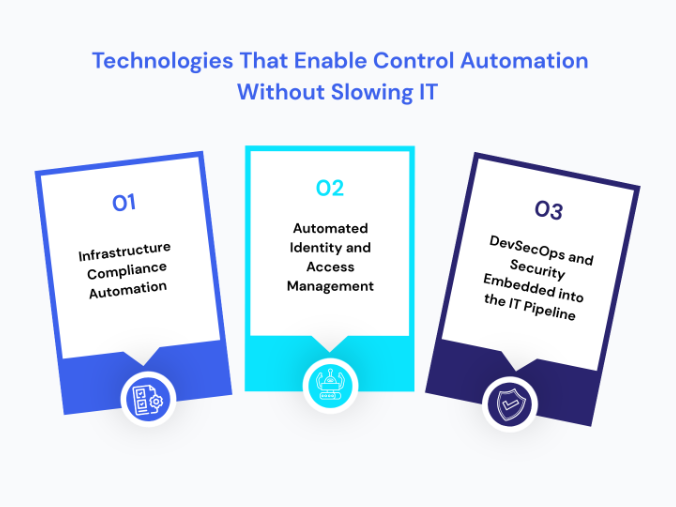
A. Infrastructure Compliance Automation
Modern platforms enable automated infrastructure compliance through:
- Continuous configuration scans
- Automated cloud and on-premise verification
- Detection of configuration drifts
- Automated remediation
According to Microsoft Security, more than 80% of cybersecurity incidents stem from misconfigurations or poor access management.
Nexfing Insight
Automating infrastructure audits eliminates reliance on periodic manual reviews.
B. Automated Identity and Access Management (IAM)
According to PwC, 61% of major security incidents in financial institutions involve poor access management.
Intelligent IAM systems enable:
- Detection of anomalous access
- Monitoring of unusual behaviours
- Dynamic privilege adjustments
- Full audit traceability
Nexfing Insight
In a digital banking environment, access control must become contextual, dynamic, and intelligent.
C. DevSecOps: Embedding Security into the IT Pipeline
According to Deloitte, organizations integrating security into DevOps pipelines reduce time-to-production by 30–40% while improving compliance.
DevSecOps enables:
- Automated code scanning
- Continuous vulnerability testing
- Pre-release compliance validation
- Automated audit trails
Nexfing Insight
The most effective control is the one that prevents risk before it reaches production.
4. Why This Transformation Is Especially Critical in Africa
The African banking market is experiencing one of the fastest digital growth rates worldwide.
According to Capgemini, Africa is among the regions with the highest adoption of digital financial services between 2024 and 2025.
At the same time, cyber threats are increasing.
According to INTERPOL, financial cybercrime in Africa rose significantly in 2025, with increases exceeding 30% in some regions.
This creates unprecedented pressure on financial institutions.
African banks must:
- Scale operations rapidly
- Handle increasing transaction volumes
- Maintain strict regulatory compliance
- Secure infrastructures despite limited specialized talent
Nexfing Strategic Recommendations
To successfully implement intelligent operations automation:
1. Standardize Control Policies
Automation requires clear, structured rules.
2. Prioritize Critical Processes
Start with:
- Digital onboarding
- IAM
- Regulatory compliance
- Infrastructure security
3. Deploy Progressively
Avoid “big bang” transformations.
4. Measure Performance
Track key KPIs:
- Average validation time
- Compliance rate
- Incident reduction
- Operational ROI
Conclusion: Can Compliance and Speed Really Coexist?
The answer is yes, but only if financial institutions rethink their approach.
Compliance must no longer be treated as a standalone validation step. It must become a native, continuous, and automated capability.
Today, automating security controls without slowing IT is not just possible — it is essential for institutions aiming to balance innovation, security, and performance
Are your control processes slowing down your operations more than they secure them?
Nexfing combines expertise in intelligent automation, cybersecurity, IT governance, and digital transformation to help financial institutions:
- Automate control workflows
- Embed security into operations
- Strengthen compliance without added complexity
- Accelerate digital transformation sustainably
Contact Nexfing to design a more agile and secure operational architecture, ready for future challenges.
Sources
- Security Magazine: https://www.securitymagazine.com/articles/100630-misconfigurations-drive-80-of-security-exposures
- Capgemini: https://www.capgemini.com/fr-fr/actualites/cas-client/renforcer-la-cybersecurite-avec-la-gestion-des-acces-privilegies/
- McKinsey: https://www.mckinsey.com/capabilities/tech-and-ai/our-insights/the-top-trends-in-tech
- INTERPOL: https://www.interpol.int/fr/Actualites-et-evenements/Actualites/2025/Un-nouveau-rapport-d-INTERPOL-met-en-garde-contre-la-forte-augmentation-de-la-cybercriminalite-en-Afrique
- IBM: https://www.ibm.com/fr-fr/think/x-force/2025-cost-of-a-data-breach-navigating-ai
- PwC: https://www.pwc.com/gx/en/issues/cybersecurity/global-digital-trust-insights-sectors/financial-services.html
- ITSocial: https://itsocial.fr/intelligence-artificielle/intelligence-artificielle-articles/la-fin-de-lere-exploratoire-place-aux-agents-a-lia-integree-et-a-lindustrialisation/