
Globally, the number of people who have access to formal finance is growing; in 2024 approximately 40% of adults with access to formal finance in the developing world had a formal savings account, which represents an increase of 16% points from 2021. Digital channels have played a significant role in this expansion by reducing the cost of serving low-income and remote customers and by creating opportunities for new types of businesses based on data and automation.
In Africa, the picture is both encouraging and incomplete: an estimated 55% of adults are considered financially included, yet the continent still has some of the lowest levels of access and usage globally. Sub‑Saharan Africa hosts more than half of the world’s mobile money accounts, and the share of adults with mobile money grew from about 12% in 2014 to roughly one‑third by 2021. By 2024, around 40% of adults in Sub‑Saharan Africa had a mobile money account, and 23% were actively using mobile accounts to save, far above the 9% average in other low‑ and middle-income countries.
Behind these gains lies a core problem: is technology translating into broad, deep, and fair financial inclusion, or is it only serving those who are easiest to reach?
Many women, rural households, informal workers, and micro‑entrepreneurs still struggle with limited connectivity, low digital literacy, and products that do not fit their realities.
This article follows a simple plan:
First, it outlines how emerging technologies enable increased financial access across Africa through real statistics and examples.
Second, it explores the remaining gaps and risks in today’s digital financial ecosystem.
Third, it offers concrete recommendations for building a more inclusive, resilient, and human‑centered financial system.
1. Africa’s Digital Finance Take-Off
Over the past decade, technology has moved Africa from cash‑only transactions toward dynamic digital ecosystems centered on mobile phones and agent networks. In 2014, about one‑third of adults in Sub‑Saharan Africa had a bank account; by 2021, more than half did, and almost all of that increase came from mobile money accounts rather than traditional bank accounts.
The scale is striking by 2023; there were over 330 million active mobile money accounts in Sub-Saharan Africa and more than one for every four people in the region. In 2024, about 40% of adults in the region held a mobile money account, and mobile money fueled close to 60% of formal borrowing, especially through digital loans.
Five countries: Ghana, Kenya, Senegal, Uganda, and Zambia saw around half of adults saving through mobile money accounts, showing how powerful these platforms can be when the ecosystem is supportive.
At country level, the transformation is even more visible. Kenya, often seen as a pioneer, moved from below 30% financial inclusion in the mid 2000s to above 80% by the early 2020s, largely thanks to M- Pesa and related digital services. South Africa reports that about 91% of adults have access to formal financial products and services, supported by strong banking infrastructure and digital channels, though quality and usage gaps remain.
Through its involvement in African financial systems, Deloitte has determined that the foundation of a bank’s strategy is now predicated on digital payment channels, open API ecosystem, and cloud-based architectures. Now banks can connect to retail customers and SMEs more effectively and partner with fintech. The most recent review of PwC’s Africa portfolio also speaks to how many banks are adopting a « mobile first » strategy and investing in analytics, automation and customer centered design in order to effectively compete with nimble fintechs.
Recommendations
– Banks and mobile network operators should deepen interoperability so customers can move money seamlessly across networks and between mobile wallets and bank accounts.
– Regulators can promote low‑cost, instant payment systems that make digital transactions cheaper than cash for small‑value use cases (transport, markets, micro‑payments).
– Industry players should prioritize high‑impact use cases such as salary payments, government transfers, school fees, and agricultural payments to “normalize” digital payments in daily life.
2.What Still Holds Inclusion Back?
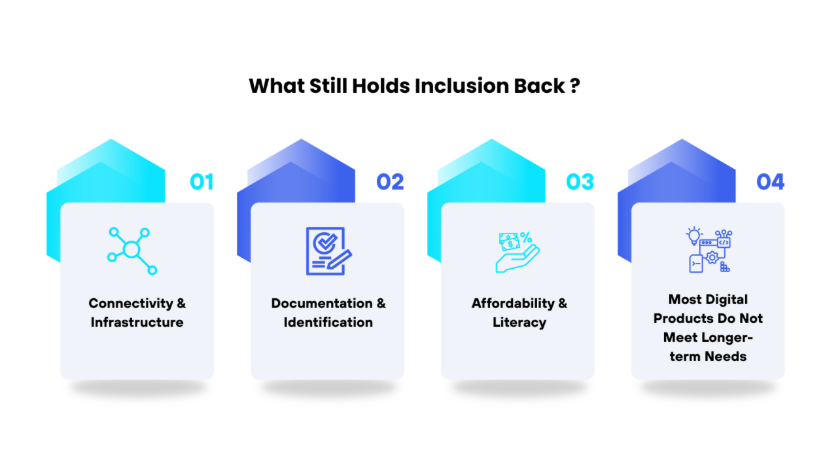
There is an evident disparity between available services versus utilizing services meaningfully as evidenced by the South African example wherein 91% of adults hold a formal bank account yet those residing in impoverished facilities or running small businesses remain without quality of life, hence creating what is known as the usage & impact gap; additionally, Sub-Saharan women, rural residents and youth face ongoing barriers to having access to use of services relative to their degree of ownership use of aforementioned services.
Several barriers explain this:
– Connectivity & Infrastructure: One of the main challenges faced by people living in rural areas is inadequate network coverage and unreliable electricity to power digital solutions.
– Documentation & Identification: Adults living in rural areas may not have access to the identification required to open an account (such as ID, passport or driver’s license). Although some countries offer « tiered KYC » regulations, rural adults still often lack access to this type of identification.
– Affordability & Literacy: For rural consumers, cost can be prohibitively high compared to their overall income; many consumers do not have sufficient financial or digital skills which increases the risk of financial fraud.
– Most Digital Products Do Not Meet Longer-term Needs: Most digital products available today are either simple Peer-to-Peer (P2P) transfers or short-term loans rather than products such as savings, insurance and/or business financing that address the needs of the consumer.
Recommandions
– Governments should invest in foundational digital ID systems linked to inclusive KYC rules, making it easier to open accounts remotely and at low cost.
– Regulators and providers need to embed strong consumer protection and data‑privacy frameworks, including clear recourse mechanisms and transparent pricing.
– Providers should segment customers (by gender, occupation, location) and co‑design products that reflect actual cash‑flow patterns, rather than simply digitizing existing banking products.
3. From Products to Inclusive Ecosystems
Technology has moved Africa from isolated products to increasingly integrated ecosystems that link payments, savings, credit, and services in other sectors such as agriculture, health, and education. Studies of Tanzania and Ghana, for example, show that inclusive payment ecosystems emerge when regulators allow non‑bank e‑money issuers, encourage agent networks, and support interoperability across providers.
Digital ecosystems matter because they multiply benefits: digital wage and government payments can bring unbanked adults into the system, merchant payments create transaction histories for micro‑entrepreneurs, and digital savings and insurance can help households cope with shocks. In Sub‑Saharan Africa, 23% of adults now save using mobile accounts, and in several countries around half of the adult population uses mobile money to save, illustrating how ecosystems can shift behavior.
Deloitte and Mastercard highlight that partnerships- between banks, mobile operators, fintechs, and governments- are essential to scale these ecosystems and reduce reliance on cash. PwC’s insights on African banks show that many institutions are moving toward platform models, exposing APIs that allow fintechs and third parties to build services for SMEs, farmers, and underserved consumers on top of core banking infrastructure.
Recommendations
– Encourage open-banking and open-finance frameworks that allow secure data-sharing (with consent) so that fintechs can build tailored services for thin-file customers.
– Support cross‑sector platforms in agriculture, health, and education that integrate payments, credit, and insurance into the services people already use.
– Incentivize partnerships through regulatory sandboxes and innovation hubs where banks, fintechs, and regulators can test new models safely.
4. The Way Forward
Technology has already helped Africa leapfrog traditional banking models, with mobile money accounts now used by around four in ten adults in Sub‑Saharan Africa and more than half of global mobile money users living in the region. Yet the next phase of inclusion will be measured not just by how many people have accounts, but by whether these services support real prosperity: more resilient households, stronger small businesses, and fairer opportunities for women and youth.
To get there, African countries will need to combine four elements: robust digital infrastructure and identity systems; clear and proportionate regulation; innovative, data‑driven financial products; and a culture of partnership across the public and private sectors. Each stakeholder group has a role to play-governments as enablers, regulators as guardians of trust, financial institutions and fintechs as innovators, and ecosystem builders as connectors.
Recommendations
– Policymakers should set national financial inclusion and digitalization targets, linked to measurable indicators (usage, gender gaps, rural coverage), and review them regularly.
– Financial institutions and fintechs should adopt responsible‑innovation principles, ensuring that AI‑driven credit, digital lending, and data use do not deepen over‑indebtedness or exclusion.
– Development partners and investors should prioritize funding for interoperable infrastructure, inclusive data systems, and capacity‑building rather than isolated pilots.
At Nexfing, the mission is to turn this vision into reality by helping organizations to deploy digital journeys that are inclusive by simple design, mobile-first interfaces; data- driven insights on underserved segments; with existing banking and payment infrastructure.
Sources:
The World Bank : https://thedocs.worldbank.org/en/doc/aad79e38a52b9d91c348a7a2d6b2c23b-0050062024/original/SSA-Overview-Note.pdf
Our World in Data: https://ourworldindata.org/mobile-money-why-it-matters
Ecofin agency : https://www.ecofinagency.com/news-finances/1807-47750-sub-saharan-africa-s-mobile-money-drives-savings-for-23-of-adults-in-2024-world-bank
Econstor: https://www.econstor.eu/bitstream/10419/286347/1/wp-2023-18.pdf
World Bank: https://www.worldbank.org/en/publication/globalfindex
Federal Deposit Insurance Corporation (FDIC) : https://www.fdic.gov/system/files/2024-08/measuring-financial-inclusion-the-global-findex-database.pdf
European Investment Bank (EIB): https://www.eib.org/files/publications/20240033_finance_in_africa_chapter5_en.pdf
The City UK: https://www.thecityuk.com/news/kenya-looks-to-fintech-to-supercharge-financial-inclusion/
Pwc : https://www.pwc.com/ke/en/press-room/africa-annual-review-2023.html
Afis Africa : https://www.afis.africa/en/where-is-africas-financial-industry-headed-six-early-afis-deloitte-barometer-insights/
FinDev Gateway : https://www.findevgateway.org/paper/2018/06/building-inclusive-payment-ecosystems-tanzania-and-ghana
The little Data Book On Financial Inclusion :
https://thedocs.worldbank.org/en/doc/be6615202d1f08a25855c8ac2d615122-0050012025/related/Little-Data-Book-2025-Web.pdf